
Introduction
Choosing the right headphones can make a significant difference to how you enjoy music, attend calls, watch videos, or listen to podcasts. However, with so many options available, one common question remains: should you choose noise-cancelling headphones or standard headphones?
Both types offer advantages, but the best option depends on your lifestyle, listening habits, budget, and the environments in which you use them. Noise-cancelling headphones are designed to reduce unwanted background noise, while standard headphones generally rely on their physical design and ear coverage to provide varying levels of isolation.
In this guide, we explain the key differences between noise-cancelling and standard headphones, their benefits and limitations, and how to choose the right option for your everyday needs.
What Are Noise-Cancelling Headphones?
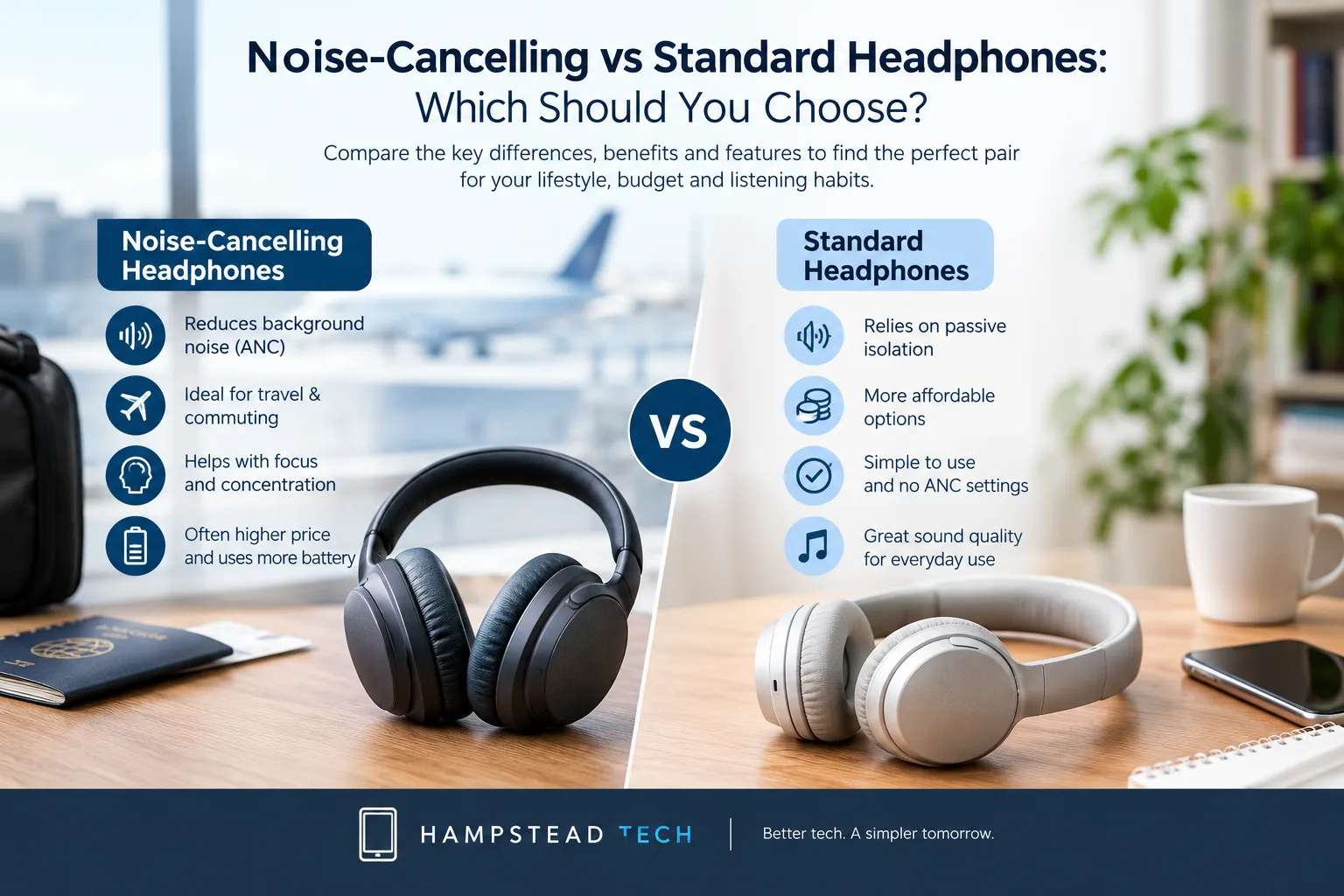
Noise-cancelling headphones are designed to reduce unwanted sounds from your surroundings. Many models use active noise cancellation (ANC), a technology that uses microphones and electronic processing to counteract external noise.
The system detects incoming sounds and produces an opposing sound signal to reduce the noise you hear. ANC is particularly effective against consistent, low-frequency sounds, such as the hum of an aeroplane engine, air conditioning, or some forms of traffic noise.
Some headphones also provide passive noise isolation through padded earcups or snug-fitting ear tips. This helps block sound physically, complementing the active noise-cancelling system.
Key Benefits of Noise-Cancelling Headphones
Reduced background noise: ANC can make noisy environments more comfortable for listening.
Improved concentration: Reducing distracting sounds can help when studying, working, or travelling.
More comfortable listening: You may find it easier to hear your audio without competing as much with background noise.
Useful travel companion: Noise cancellation can be especially helpful on aeroplanes, trains, and other noisy forms of transport.
Enhanced listening experience: Depending on the model and environment, less background noise can help you notice more detail in your music, podcasts, or other audio.
Potential Drawbacks
Noise-cancelling headphones often cost more than comparable standard models. Active noise cancellation also consumes battery power on wireless headphones, and its effectiveness varies by device and type of noise.
Some users experience pressure-like sensations or discomfort when ANC is enabled. Others may notice a slight difference in sound quality or performance depending on the headphone design.
It is also important to remember that ANC does not eliminate every sound. Sudden noises, nearby conversations, and high-frequency sounds may remain audible.
What Are Standard Headphones?
Standard headphones are headphones that do not use active noise cancellation. They may be wired or wireless, over-ear or on-ear, and can still deliver excellent audio quality.
Many standard headphones provide passive noise isolation through their physical construction. Over-ear models with well-fitted earcups can reduce some external noise, while in-ear headphones may block a degree of sound through their ear tips.
Their main appeal is simplicity, affordability, and the wide range of designs available.
Key Benefits of Standard Headphones
Budget-friendly options: You can find suitable headphones at a range of price points without paying extra for ANC.
Simple operation: There is no active noise-cancelling system to configure.
No ANC battery requirement: Wired models can operate without a battery for audio playback, while wireless models still require power for their Bluetooth connection and other electronic features.
Wide selection: There are options for casual listening, gaming, studying, office work, and everyday entertainment.
Potentially excellent sound quality: A well-designed standard headphone can deliver detailed, balanced audio without active noise cancellation.
Potential Drawbacks
Standard headphones may be less effective at reducing consistent background noise, particularly in busy public spaces. You might need to increase the volume to hear your audio clearly when your surroundings are loud.
However, turning the volume up excessively can increase the risk of hearing damage. A better-fitting pair or a quieter listening environment is preferable to relying on high volume.
Noise-Cancelling vs Standard Headphones: Key Differences
Understanding the main differences can help you decide which type is better suited to your needs.
Neither type is automatically better in every situation. Your ideal choice depends on where you listen, what you listen to, and how much you want to spend.
Which Headphones Are Better for Everyday Use?
The right choice becomes clearer when you consider how you plan to use your headphones.
1. For Travelling and Commuting
If you regularly use buses, trains, or aeroplanes, noise-cancelling headphones can be a worthwhile investment.
The ability to reduce steady background noise can make journeys more comfortable, especially when listening to music, podcasts, or audiobooks. Over-ear ANC headphones may be particularly suitable for longer trips, although compact noise-cancelling earbuds are convenient if you prefer something portable.
If you only travel occasionally or use headphones for short journeys, standard headphones with a comfortable fit may provide sufficient performance at a lower cost.
Best choice: Noise-cancelling headphones for frequent travellers.
2. For Working and Studying
Background noise can make it harder to concentrate, particularly in shared offices, libraries with surrounding activity, or busy homes.
Noise-cancelling headphones can reduce some environmental distractions and make calls or focused listening more comfortable. Some models also feature transparency modes, which allow outside sound to pass through when you need to hear people around you.
Standard headphones can be equally suitable if you work in a quiet room or simply want music playing while you study.
Best choice: Noise-cancelling headphones for noisy workspaces; standard headphones for quieter environments.
3. For Listening to Music at Home
If you primarily listen to music at home, you may not need active noise cancellation.
A good pair of standard headphones can provide excellent sound quality, comfort, and value. Depending on your preferences, you might prioritise balanced audio, strong bass, a wide soundstage, or a wired connection.
Noise-cancelling headphones can still be useful if other people in your home create distractions or if you want to listen without being disturbed by appliances and other background sounds.
Best choice: Standard headphones for quiet surroundings; noise-cancelling models for shared or noisy spaces.
4. For Phone Calls and Online Meetings
If you regularly take work calls, attend online meetings, or make calls while travelling, pay attention to microphone quality as well as noise cancellation.
ANC primarily reduces sounds reaching your ears. It does not automatically guarantee that the person on the other end will hear your voice clearly.
Some headphones offer separate microphone noise reduction to help minimise background sounds during calls. Others perform better in quiet rooms.
Before choosing a pair, look for microphone tests, call-quality reviews, and compatibility with your phone or computer.
Best choice: Either type can work well, provided it offers a good microphone and reliable connectivity.
5. For Gaming and Entertainment
For gaming, watching films, or streaming content, comfort and sound performance are often more important than ANC alone.
Consider factors such as audio positioning, latency, microphone quality, connectivity, and compatibility with your gaming platform. Wired headphones may be useful when low latency is important, while wireless models provide more freedom of movement.
Noise cancellation can be beneficial if you play in a noisy environment, but it is not essential for every gamer.
Best choice: Choose based on comfort, audio performance, and your gaming setup.
Are Noise-Cancelling Headphones Worth the Extra Cost?
Noise-cancelling headphones can be worth the additional expense if you frequently encounter background noise.
For example, someone who travels daily, works in an open office, or regularly studies in shared spaces may appreciate ANC throughout the week. Over time, the added convenience can justify paying more for the feature.
On the other hand, if you mainly listen at home in a quiet room, standard headphones may offer everything you need.
Before spending extra, consider the following:
How often do you use headphones?
Are your surroundings usually noisy?
Do you travel regularly?
Is ANC important enough to justify the additional cost?
Would better comfort, battery life, or sound quality matter more to you?
Comparing the complete package is more useful than choosing headphones based on one feature alone.
What to Consider Before Buying Headphones
Whether you choose noise-cancelling or standard headphones, several other factors can influence your experience.
Comfort and Fit
Headphones should feel comfortable during extended listening sessions. Check the weight, headband pressure, earcup padding, and adjustability of over-ear models. For earbuds, consider the fit and availability of different ear-tip sizes.
A comfortable fit also helps provide consistent passive noise isolation.
Sound Quality
Consider your preferred listening style. Some headphones emphasise bass, while others offer a more balanced sound. Look for reviews that assess audio quality across music, speech, and other content relevant to you.
Battery Life
For wireless headphones, compare the manufacturer’s stated battery life and check whether it differs when ANC is enabled. Quick charging can also be useful if you regularly forget to charge your devices.
Connectivity and Compatibility
Check whether the headphones support Bluetooth, a wired connection, or both. Confirm compatibility with your smartphone, tablet, laptop, or other devices.
If you plan to use them for gaming or professional calls, also check latency, microphone features, and supported connections.
Durability and Warranty
Look for sturdy construction, reliable controls, and clear warranty terms. If you intend to carry your headphones in a bag every day, a folding design or protective case may be useful.
Safety and Awareness
Noise cancellation and strong passive isolation can make it harder to hear traffic, announcements, or people nearby. Use an appropriate transparency mode where available, and remain aware of your surroundings when walking, cycling, or travelling near roads.
Listening at moderate volume is also important, regardless of which headphone type you choose.
Common Mistakes to Avoid When Choosing Headphones
Avoid these mistakes when comparing your options:
Assuming ANC guarantees better sound quality. Noise cancellation and audio quality are different features. Evaluate both independently.
Ignoring comfort. Even excellent headphones can become frustrating if they feel uncomfortable after a short period.
Paying for features you will not use. If you rarely encounter background noise, ANC may not be a priority.
Overlooking microphone quality. This matters if you frequently attend calls or online meetings.
Ignoring battery performance. Wireless headphones may have different runtimes depending on volume, ANC settings, and other features.
Using high volume to overcome background noise. Choose better-fitting headphones, use ANC where appropriate, or move to a quieter environment instead.
Making a decision based on your real listening habits will help you avoid unnecessary spending.
Frequently Asked Questions
Are noise-cancelling headphones better than standard headphones?
Not necessarily. Noise-cancelling headphones are generally better at reducing certain types of background noise, while standard headphones can offer excellent sound quality and value. The best option depends on your environment and priorities.
Do noise-cancelling headphones block all outside noise?
No. Active noise cancellation is particularly effective against many steady, low-frequency sounds, but it cannot eliminate every sound. Conversations, sudden noises, and some higher-frequency sounds may still be audible.
Are standard headphones better for your ears?
Neither type is automatically safer. Hearing safety depends largely on listening volume, duration, and exposure. Keep the volume at a comfortable level and take regular listening breaks.
Can you use noise-cancelling headphones without ANC?
Many models allow you to turn ANC off. However, the available modes and whether the headphones work passively vary by model. Check the manufacturer’s specifications before buying.
Are noise-cancelling headphones worth it for studying?
They can be useful if you study in busy environments. If you usually work in a quiet room, standard headphones may be sufficient.
Do noise-cancelling headphones help with phone calls?
They can make it easier for you to hear calls in noisy environments, but microphone performance varies. Look for models with effective microphone noise reduction if call clarity is a priority.
Final Verdict: Which Should You Choose?
The choice between noise-cancelling and standard headphones comes down to your daily routine, listening environment, and budget.
Choose noise-cancelling headphones if you travel frequently, work in noisy spaces, or want to reduce distracting background sounds while listening.
Choose standard headphones if you primarily listen in quiet environments, want to keep costs down, or prefer a simpler design without active noise cancellation.
Whichever option you choose, prioritise comfort, sound quality, compatibility, and reliable performance. The best headphones are the ones that fit your needs rather than simply offering the longest feature list.
If you need help with your everyday technology, device accessories, or related support, visit Hampstead Tech to explore its services and get in touch with the team.
SEO Details
SEO title: Noise-Cancelling vs Standard Headphones: Which Is Best?
Meta description: Compare noise-cancelling vs standard headphones to discover the differences in sound, comfort, price, and battery life, and find the right pair for you.
Suggested URL slug: /noise-cancelling-vs-standard-headphones/
Primary keyword: Noise-cancelling vs standard headphones
Secondary keywords: Noise-cancelling headphones, standard headphones, active noise cancellation, ANC headphones, best headphones for travelling, headphones for studying, headphone buying guide
Suggested category: Technology Guides / Buying Advice
Need this fixed?
We repair these at our workshop at 47 Hampstead High Street, London NW3 1QG. Read more about phone repair in Hampstead, or book a repair online.